
Eliminating Sinkhole Formation Through Internal Infrastructure Repair
HydraTech Field Services
Market
Commercial / Stormwater
Challenge
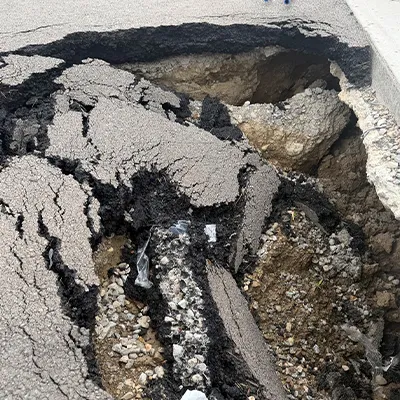
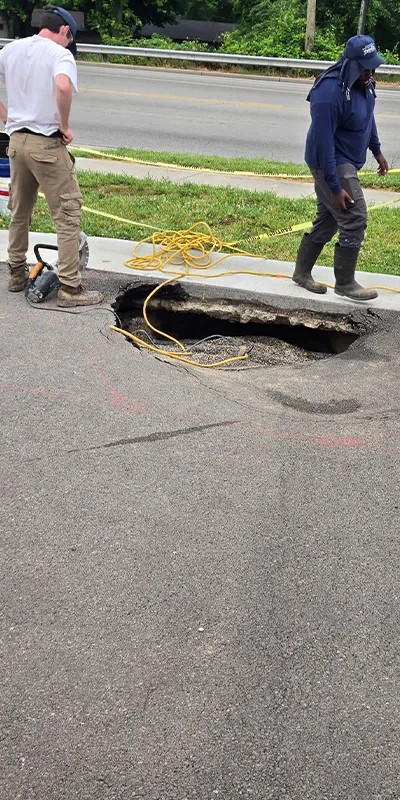
A commercial car wash discovered a developing sinkhole after pavement above a stormwater system began to settle and partially collapse. Investigation revealed that an aging stormwater pipe had gradually become deformed, preventing it from properly connecting where it entered the manhole junction box. The resulting gap allowed groundwater to infiltrateand surrounding soils to migrate into the manhole, creating an underground void that eventually caused the surface pavement to fail.
The owner required more than a surface repair. To prevent the sinkhole from reoccurring, the source of the infiltration had to be identified and permanently eliminated before the damaged pavement could be restored.
Repair Stategy
Rather than simply filling the sinkhole, the Field Services team developed a repair plan that addressed the underlying cause of the failure. The project began by verifying the exact infiltration pathway before repairing the defective pipe-to-manhole connection using polyurethane chemical grout injection. Once the leaking penetration was stabilized, the underground void and surface pavement could be reconstructed with confidence that future soil migration had been eliminated.
Scope
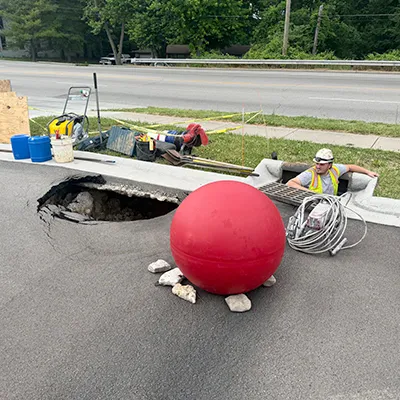
Before repairs began, technicians performed a controlled water test to confirm the source of the infiltration. Water introduced at the sinkhole on the surface was observed entering through the defective pipe penetration inside the manhole, confirming the exact location requiring rehabilitation.
The damaged pavement was then removed using a freehand chop saw, exposing the void beneath the surface. Approximately 2.5 tons of fill material were placed, compacted, and graded to rebuild the subsurface foundation.
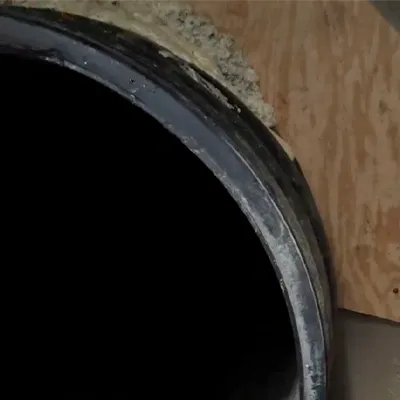
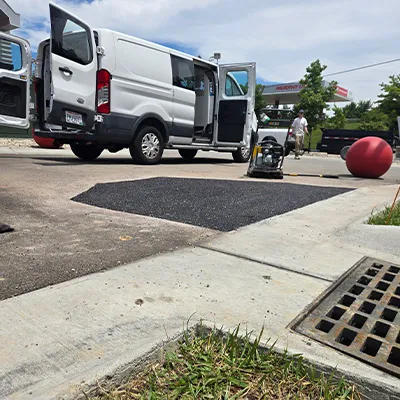
Inside the manhole, deteriorated material surrounding the pipe penetration was removed, and filler was placed in the void between the wall of the manhole junction box and the end of the pipe. Then a wooden form was constructed around the connection point. Polyurethane chemical grout was then injected behind the form, creating a barrier against debris falling into the manhole junction box. Following completion of the internal repair, approximately twenty 50-pound bags of asphalt were placed, compacted, and finished to restore the parking lot to its original grade.
Solution
The repair successfully restored this defective connection that had been responsible for washing soil into the stormwater structure and creating the underground void. With the pipe penetration rehabilitated and the pavement fully restored, the sinkhole was eliminated, and the parking area was safely returned to service.
This project highlights the Field Services team’s ability to diagnose complex underground infrastructure problems, develop customized repair strategies, and restore aging stormwater systems. By combining trenchless rehabilitation techniques with surface restoration, the team delivered a comprehensive solution that addressed both the visible damage and the underlying cause.
 Explore Field Services
 More Products
 Case Studies
Explore Field Services
More Products
Case Studies
Explore Field Services
More Products
Case Studies

OUR PRODUCTS
Trenchless Repairs Custom Made

OUR INDUSTRIES
From Power to Water We Have It Covered

OUR RESOURCES
Technical Data Sheets and Product Literature